








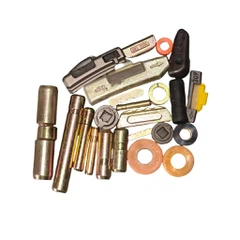
1. Determine the Application Scenario & Load Requirements
The first step in choosing a nut is to clarify its use scenario, as this directly determines the load capacity, corrosion resistance, and durability required. For bucket teeth and heavy machinery applications, focus on the following factors:
Load Type: If the nut is used for bucket teeth connection (subject to frequent impact, vibration, and shear force), choose nuts with high tensile strength and anti-loosening performance. For static load scenarios (e.g., fixed auxiliary parts), standard nuts may suffice.
Working Environment:
Outdoor/construction sites: Nuts need corrosion resistance (against rain, soil, and chemicals).
High-temperature environments: Select heat-resistant materials to avoid deformation.
Humid/coastal areas: Prioritize anti-rust treatments (e.g., galvanization, chrome plating).
Equipment Compatibility: For bucket teeth, ensure the nut matches the bolt used in the tooth point and adapter connection (e.g., the bolt size and thread type of CAT, Komatsu, or Sany bucket teeth).
2. Match the Bolt Specifications
Nuts and bolts must be perfectly matched to ensure a secure connection. Key matching points include:
Thread Type: The most common types are metric (M series, e.g., M8, M10) and imperial (UNC/UNF). Ensure the nut's thread matches the bolt-mixing metric and imperial threads will cause loose connections or damage.
Thread Pitch: Even with the same nominal size, fine-pitch and coarse-pitch threads differ. For example, M10 has coarse pitch (1.5mm) and fine pitch (1.25mm); the nut must match the bolt's pitch.
Bolt Grade: Nuts should have a grade corresponding to the bolt to avoid strength mismatch. For high-strength bolts (e.g., 8.8, 10.9 grade used in bucket teeth), choose high-strength nuts (same grade or higher) to prevent the nut from stripping under load.
3. Select the Right Nut Type
Different nut types have unique characteristics, suitable for different scenarios. For bucket teeth and heavy machinery, the following types are most commonly used:
3.1 Hexagonal Nut (Hex Nut)
The most widely used type, with six sides for easy tightening with a wrench. Available in two styles:
Standard Hex Nut: Suitable for general static load connections; cost-effective and easy to install.
Thick Hex Nut: Has a longer height, higher load-bearing capacity, and better stability-ideal for bucket teeth and other high-vibration, high-impact applications.
3.2 Lock Nut (Anti-Loosen Nut)
Designed to prevent loosening caused by vibration (critical for bucket teeth, which experience frequent impact during operation). Common types:
Nylon Insert Lock Nut: Features a nylon ring inside the nut; when tightened, the ring presses against the bolt thread to create friction and prevent loosening. Suitable for low to medium vibration scenarios.
All-Metal Lock Nut: Uses a deformed thread or metal washer to achieve anti-loosening. High-temperature resistant and suitable for heavy-duty, high-vibration environments (e.g., bucket teeth in mining or rock excavation).
3.3 Flange Nut
Integrates a flange (washer) at the bottom, eliminating the need for an additional washer. The flange increases the contact area, distributes pressure, and prevents the nut from sinking into the material-ideal for connecting thin or soft components in auxiliary parts of bucket teeth.
4. Choose the Appropriate Material
Nut material directly affects its strength, corrosion resistance, and service life. For bucket teeth and heavy machinery, common materials include:
Carbon Steel: Low cost, high strength, but poor corrosion resistance. Suitable for indoor, dry environments or temporary connections. Common grades: 4.8, 8.8.
Alloy Steel: Added with chromium, molybdenum, or nickel to improve strength and toughness. High-strength alloy steel nuts (10.9, 12.9 grade) are ideal for bucket teeth and other heavy-load applications.
Stainless Steel: Excellent corrosion resistance, suitable for humid, outdoor, or coastal environments. Common grades: 304 (general corrosion resistance) and 316 (better corrosion resistance for harsh environments).
Coated Nuts: For enhanced corrosion resistance, choose nuts with surface treatments such as hot-dip galvanization, electroplating, or Dacromet. These coatings are ideal for bucket teeth used in construction sites with rain, soil, or chemical exposure.
5. Consider Additional Factors
Installation Space: If the installation area is narrow (e.g., inside the bucket tooth adapter), choose thin or slotted nuts for easy operation.
Torque Requirements: High-strength nuts require precise torque during installation to ensure the connection is tight without damaging the thread. Use a torque wrench for accurate tightening.
Cost-Effectiveness: Balance performance and cost. For non-critical auxiliary parts, standard carbon steel nuts are sufficient; for bucket teeth connections (critical for safety), invest in high-strength, anti-loosening nuts to avoid costly downtime.